
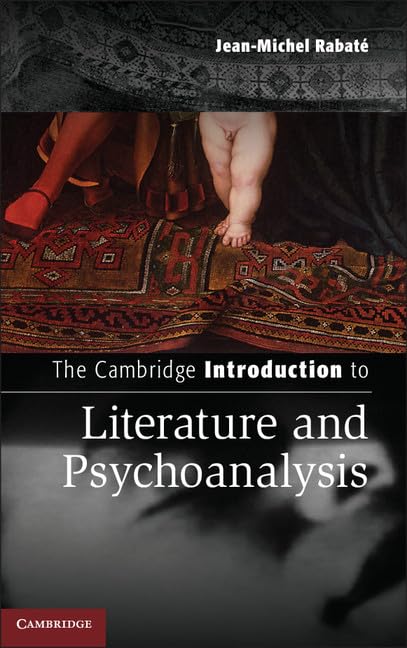
The Cambridge Introduction to Literature and Psychoanalysis / Jean-Michel Rabaté
Material type: TextPublication details: Cambridge : Cambridge University Press, c2014.Description: vii, 255pISBN:
 - 9781107423916
- 801.92 RabC
| Item type | Current library | Collection | Call number | Status | Barcode | |
|---|---|---|---|---|---|---|
 Books
Books
|
Indian Institute of Technology Tirupati General Stacks | Humanities | 801.92 RabC (Browse shelf(Opens below)) | Available | 10899 |
Browsing Indian Institute of Technology Tirupati shelves, Shelving location: General Stacks, Collection: Humanities Close shelf browser (Hides shelf browser)

|

|

|

|

|
|

|
||
| 801 HamL Literature in the Digital Age : An Introduction / | 801 RivL3 Literary Theory: An Anthology / | 801.9 EnrE English Critical Texts : 16th Century to 20th Century / | 801.92 RabC The Cambridge Introduction to Literature and Psychoanalysis / | 801.95 CulL2 Literary Theory : A Very Short Introduction / | 801.95 CulL2 Literary Theory : A Very Short Introduction / | 801.95 KroI (11749) Introducing English Studies / |
Machine generated contents note: 1. Freud's theater of the unconscious: Oedipus, Hamlet, and 'Hamlet'; Literature and fantasy, towards a grammar of the subject; 3. From the uncanny to the unhomely; 4. Psychoanalysis and the paranoid critique of pure literature; 5. The literary phallus, from Poe to Gide; 6. A thing of beauty is a Freud for ever: Joyce with Jung and Freud, Lacan, and Borges; 7. From the history of perversion to the trauma of history.
"This volume is an introduction to the relationship between psychoanalysis and literature. Jean-Michel Rabaté takes Sigmund Freud as his point of departure, studying in detail Freud's integration of literature in the training of psychoanalysts and how literature provided crucial terms for his myriad theories, such as the Oedipus complex. Rabate; subsequently surveys other theoreticians such as Wilfred Bion, Marie Bonaparte, Carl Jung, Jacques Lacan, and Slavoj Žižek. This Introduction is organized thematically, examining in detail important terms like deferred action, fantasy, hysteria, paranoia, sublimation, the uncanny, trauma, and perversion. Using examples from Miguel de Cervantes and William Shakespeare to Sophie Calle and Yann Martel, Rabaté demonstrates that the psychoanalytic approach to literature, despite its erstwhile controversy, has recently reemerged as a dynamic method of interpretation"--
There are no comments on this title.