
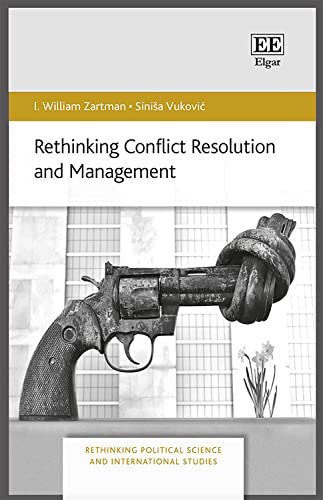
Rethinking Conflict Resolution and Management / I. William Zartman and Siniša Vuković
Material type: TextLanguage: English Publication details: Massachusetts : Edward Elgar, ©2023.Description: ix, 186pISBN:
 - 9781800376984
- 303.69 ZarR
| Item type | Current library | Collection | Call number | Copy number | Status | Barcode | |
|---|---|---|---|---|---|---|---|
 Books
Books
|
Indian Institute of Technology Tirupati General Stacks | Non-fiction | 303.69 ZarR (11692) (Browse shelf(Opens below)) | Copy 01 | Available | 11692 |
Browsing Indian Institute of Technology Tirupati shelves, Shelving location: General Stacks, Collection: Non-fiction Close shelf browser (Hides shelf browser)

|

|

|

|

|

|

|
||
| 153.1 SurP (11999) Principles of Memory / | 180 PerA (11725) Ancient Philosophy : Textual Paths and Historical Explorations / | 302 ManE (11700) Essentials of Social Psychology : An Indian Perspective / | 303.69 ZarR (11692) Rethinking Conflict Resolution and Management / | 306.014 BroG3 (11727) A Glossary of Literary and Cultural Theory [3rd ed.] / | 306.071 WilC (12006) Culture and Politics : Class, Writing, Socialism / | 306.44 MonL (11726) Language, Media and Culture : The Key Concepts / |
Rethinking and revising the established knowledge and practice of conflict resolution and management, this innovative book brings together complementary perspectives to consider novel approaches to resolving conflict after the collapse of the World Order.
Examining the current system of world disorder, the authors identify ways of operating constructively and navigating conflict in order to better manage and resolve it. Analysing conventional and hybrid conflict at both international and internal state level, they look to transform current scholarship on conflict resolution and management in international relations. Chapters rethink mediation; power in peace-making; prevention of escalation; governance, protest and revolt; inclusion and representation; and the individual as subject and object in conflict resolution and management. Paving the way for future research in the field, the book outlines the need to learn how to operate within the present world disorder in order to prevent the descent into entropy. By awakening realistic creativity and examining present characteristics and future possibilities, the book develops a more positive evolution which can reinstitute an effective new system of World Order.
Both prescriptive and analytical in approach, this insightful book will prove vital to students and scholars of international relations, political science and public policy, alongside policy makers looking to rethink their conflict resolution and management methods.
There are no comments on this title.