
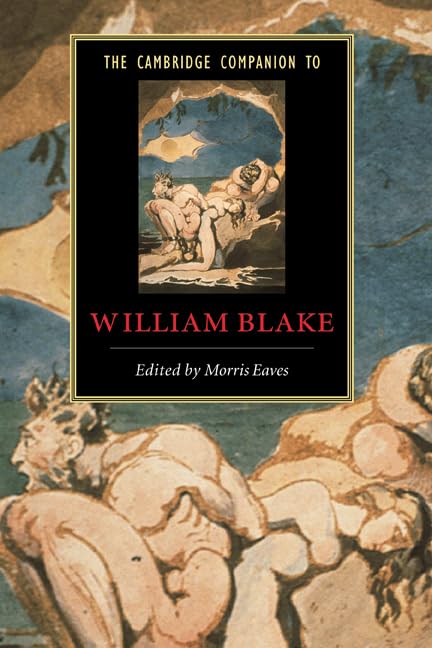
The Cambridge Companion to William Blake / edited by Morris Eaves
Language: English Series: Cambridge Companions to LiteraturePublication details: United Kingdom : Cambridge University Press, ©2003.Description: xix, 302p.; 23cmISBN:- 9780521781473
- 821.7 Eav
| Item type | Current library | Collection | Call number | Copy number | Status | Barcode | |
|---|---|---|---|---|---|---|---|
 Books
Books
|
Indian Institute of Technology Tirupati General Stacks | Humanities | 821.7 EavC (11462) (Browse shelf(Opens below)) | Copy 01 | Available | 11462 |
Chronology
1. Introduction Morris Eaves
Part I. Perspectives:
2. William Blake and his circle Aileen Ward
3. Illuminated printing Joseph Viscomi
4. Blake's language Susan Wolfson
5. Blake as painter David Bindman
6. The political aesthetic of the illuminated books Saree Makdisi
7. Blake and religion Robert Ryan
8. Blake's politics in history Jon Mee
9. Blake and Romanticism David Simpson
Part II. Blake's Works:
10. Blake's early works Nelson Hilton
11. From America to The Four Zoas Andrew Lincoln
12. Milton and its contexts, 1800–1810 Mary Lynn Johnson
13. Jerusalem and Blake's final works Robert N. Essick
Appendices
Guides to Further Reading
Glossary of terms, names, and concepts Alexander Gourlay.
Poet, painter, and engraver William Blake died in 1827 in obscure poverty with few admirers. The attention paid today to his remarkable poems, prints, and paintings would have astonished his contemporaries. Admired for his defiant, uncompromising creativity, he has become one of the most anthologized and studied writers in English and one of the most studied and collected British artists. His urge to cast words and images into masterpieces of revelation has left us with complex, forceful, extravagant, some times bizarre works of written and visual art that rank among the greatest challenges to plain understanding ever created. This Companion aims to provide guidance to Blake's work in fresh and readable introductions: biographical, literary, art historical, political, religious, and bibliographical. Together with a chronology, guides to further reading, and glossary of terms, they identify the key points of departure into Blake's multifarious world and work.
There are no comments on this title.