
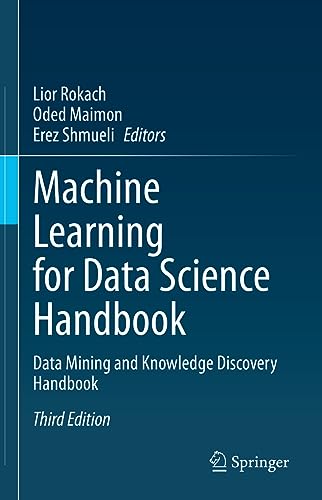
Machine Learning for Data Science Handbook : Data Mining and Knowledge Discovery Handbook [3rd ed.] / edited by Lior Rokach, Oded Maimon and Erez Shmueli
Language: English Publication details: Switzerland: Springer; ©2005Edition: 3rd edDescription: vii, 985pISBN:- 9783031246272
- 006.31 Rok3
| Item type | Current library | Collection | Call number | Copy number | Status | Barcode | |
|---|---|---|---|---|---|---|---|
 Reference
|
Indian Institute of Technology Tirupati Reference | Computer Science | REF 006.31 RokM3 (11540) (Browse shelf(Opens below)) | Copy 1 | Not for loan | 11540 |
This book is a major update to the very successful first and second editions (2005 and 2010) of Data Mining and Knowledge Discovery Handbook. Since the last edition, this field has continued to evolve and to gain popularity. Existing methods are constantly being improved and new methods, applications and aspects are introduced. The new title of this handbook and its content reflect these changes thoroughly. Some existing chapters have been brought up to date. In addition to major revision of the existing chapters, the new edition includes totally new topics, such as: deep learning, explainable AI, human factors and social issues and advanced methods for big-data. The significant enhancement to the content reflects the growth in importance of data science. The third edition is also a timely opportunity to incorporate many other changes based on peers and students’ feedback.
This comprehensive handbook also presents a coherent and unified repository of data science major concepts, theories, methods, trends, challenges and applications. It covers all the crucial important machine learning methods used in data science.
Today's accessibility and abundance of data make data science matters of considerable importance and necessity. Given the field's recent growth, it's not surprising that researchers and practitioners now have a wide range of methods and tools at their disposal. While statistics is fundamental for data science, methods originated from artificial intelligence, particularly machine learning, are also playing a significant role.
This handbook aims to serve as the main reference for researchers in the fields of information technology, e-Commerce, information retrieval, data science, machine learning, data mining, databases and statistics as well as advanced level students studying computer science or electrical engineering. Practitioners working within these related fields and data scientists will also want to purchase this handbook as a reference.
There are no comments on this title.