
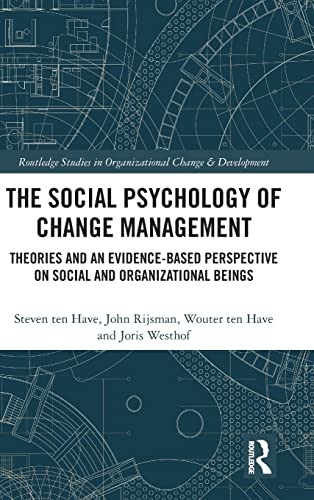
The Social Psychology of Change Management : Theories and an Evidence-Based Perspective on Social and Organizational Beings / Steven ten Have and John Rijsman
Material type: TextLanguage: English Series: Routledge Studies in Organizational Change & DevelopmentPublication details: New York : Routledge, ©2019.Description: xiii, 303pISBN:
 - 9781138552081
- 658.406 HavS
| Item type | Current library | Collection | Call number | Copy number | Status | Barcode | |
|---|---|---|---|---|---|---|---|
 Books
Books
|
Indian Institute of Technology Tirupati General Stacks | Non-fiction | 658.406 HavS (11704) (Browse shelf(Opens below)) | Copy 01 | Available | 11704 |
List of Tables and Figures
Foreword
Social Psychology and Change Management
Model and Methodology
Belonging, Organizational Behavior and Change
Understanding, Organizational Behavior and Change
Controlling, Organizational Behavior and Change
Trusting, Organizational Behavior and Change
Self-enhancing, Organizational Behavior and Change
Towards a Social Psychology of Change Management
Appendix A: Overview of Authors and Researchers
Appendix B: Examples of Matrix for each Core Social Motive
Appendix C: Bibliography
Index
Changes are rarely accomplished by individuals. People are social animals and changes are social processes which have to be organized.
Social psychology is essential for the effectiveness and development of the field of change management. It is necessary to understand people in change processes. Social psychology also teaches us that meaning is key during change and intervention. Social psychology makes change management comprehensible to people and allows them to consider their actions in groups and the organization on their merits. They may seem obvious and self-evident, but practice and science, as well as the popular change management literature, show that it is not.
Drawing on the field of social psychology and based on primary research, The Social Psychology of Change Management presents more than forty social psychological theories and concepts that are relevant for the field of change management. The theories and concepts are analyzed and categorized following Fiske’s five core social motives; belonging, understanding, controlling, enhancing self, and trusting. Each theory will have an introduction in which its assumptions and relevance is explained.
By studying the scientific evidence, including meta-analytic evidence, the book provides practitioners, students and academics in the field of change management, organizational behaviour and business strategy the most relevant social psychological ideas and best available evidence, thereby further unleashing the potential of social psychology in order to feed the field of change management. By categorizing and integrating the relevant theories and concepts, change management is enriched and restructured in a prudent, positive and practical way.
The overarching goal, however, inspired by the ideas and perspective of leading thinkers like Kurt Lewin, James Q. Wilson and Susan T. Fiske, is to make the world a better place. Social psychologists (being social scientists) study practical social issues, in our case issues related to change management, and application to real-world problems is a key goal. Therefore, this book goes beyond the domain of organizational sciences.
There are no comments on this title.